

At Revolution Medicines, Medical Affairs supports US healthcare providers in oncology by sharing rigorous scientific information related to RAS-driven cancers.
RAS in Cancer
The RAS family of proteins, which includes the canonical members KRAS, NRAS, and HRAS, share significant sequence homology and similar functions.1-4
Normal RAS Signaling
RAS proteins play a crucial role in the regulation of cell proliferation and survival in normal cells.1,2
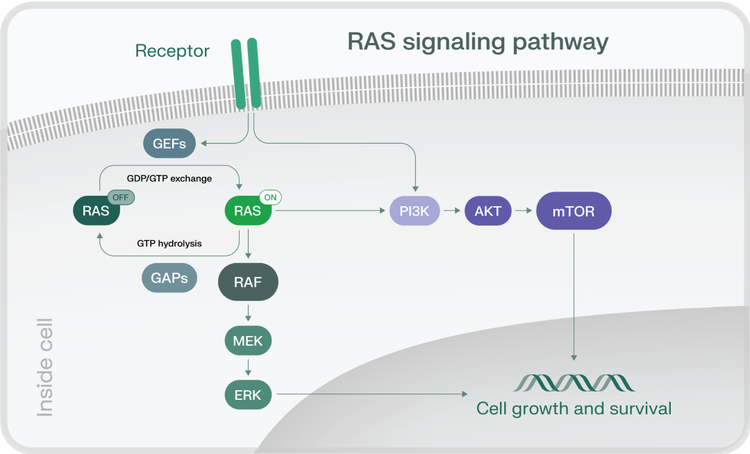
These proteins function as tightly regulated molecular switches which cycle between an active, GTP-bound [RAS(ON)] state and inactive, GDP-bound [RAS(OFF)] state. Activation is driven by GEF-mediated GDP-GTP exchange, while inactivation is a function of GAP-stimulated hydrolysis of GTP to GDP.1-3,5
When RAS is switched ON, it initiates downstream signaling that promotes cell growth, proliferation, and survival. In normal cells, RAS is predominantly in the OFF state and is only transiently switched ON in response to growth signals before returning to the OFF state. This careful regulation maintains a tight balance between RAS in its OFF and ON states.5,6
RAS in Cancer
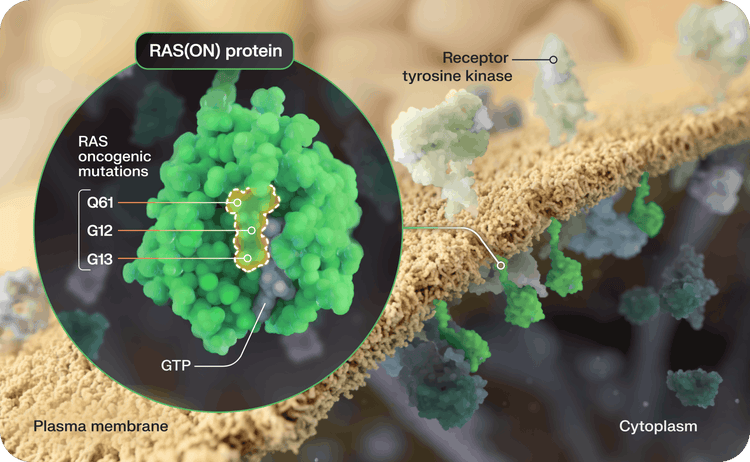
Oncogenic mutations which cause amino acid changes at G12, G13, and Q61 in RAS genes can drive cancer initiation and progression by disrupting this balance, resulting in an accumulation of RAS(ON) proteins to drive excessive RAS signaling in tumor cells.1,7 These mutations are common across multiple tumor types and are associated with poor survival outcomes.2,3,6
Why RAS matters in cancer
- RAS mutations are present in approximately one-fifth of human cancers.1
- Oncogenic mutations at amino acids G12, G13, and Q61 of RAS proteins can impair GTP hydrolysis and cause accumulation of RAS(ON), driving cancer initiation and progression.1,7
RAS mutations in cancer
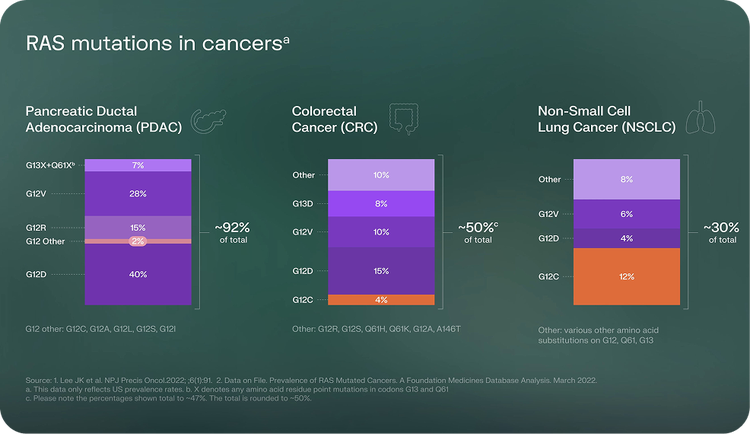
- Cancers commonly driven by RAS mutations include PDAC (~92% RAS mutant), CRC (~50% RAS mutant), and NSCLC (~30% RAS mutant), all of which exhibit a wide array of RAS mutations.1,4,8,9
- RAS is a key oncogenic driver, but there are limited therapeutic options that directly inhibit RAS.10,11
Revolution Medicines’ investigational RAS(ON) inhibitors are orally administered molecules12-15 that enter the cancer cell and bind to cyclophilin A, a naturally abundant cytosolic protein that normally does not interact with RAS.16,17
This binary complex of the RAS(ON) inhibitor bound to cyclophilin A binds to RAS in its ON state, forming an inhibitory tri-complex that can prevent RAS from activating downstream effector proteins in the signaling cascade.16-18
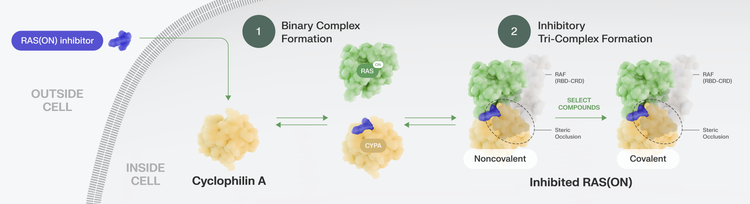
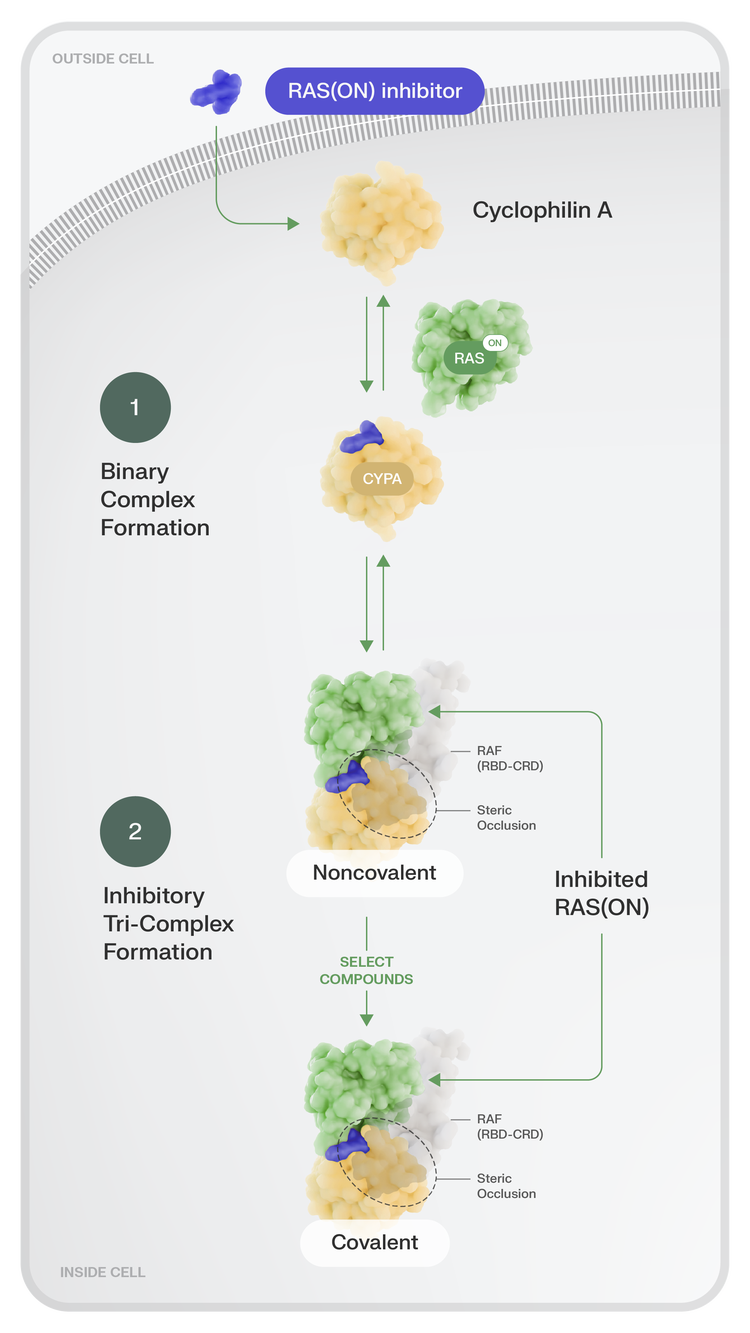
Steric hindrance may vary depending on the specific RAS(ON) inhibitor. This is intended for illustrative purposes only.
Inhibiting the function of RAS(ON) can attenuate RAS oncogenic signaling and may cause cancer regression and tumor cell death.16,17 Using this tri-complex inhibitor approach, Revolution Medicines is developing a pipeline of investigational RAS(ON) inhibitors.12,14,19-21
Revolution Medicines Investigational RAS(ON) Inhibitors
Four Investigational RAS(ON) Inhibitors Are in Clinical-Stage Trials for Targeting RAS Mutant Cancers
Daraxonrasib (RMC-6236)
A RAS(ON) multi-selective
noncovalent inhibitor16,22
Ongoing development in PDAC (1L metastatic, adjuvant resectable disease), NSCLC (1L-3L metastatic), CRC, and other advanced solid tumors19-21,23-29
As of 08/26/2026, daraxonrasib has been approved only in the United States and is indicated for the treatment of adult patients with metastatic pancreatic adenocarcinoma who have received at least one prior systemic therapy or who are not candidates for multiagent systemic therapy.30
Zoldonrasib (RMC-9805)
A RAS(ON) G12D-selective
covalent inhibitor22,31
advanced solid tumors19-21,27,32
Elironrasib (RMC-6291)
A RAS(ON) G12C-selective
covalent inhibitor22,33
RMC-5127
A RAS(ON) G12V-selective
noncovalent inhibitor22,35
Abbreviations
AKT, protein kinase B; CRC, colorectal cancer; CRD, cysteine-rich domain; CYPA, cyclophilin A; ERK, extracellular signal-regulated kinase; FDA, US Food and Drug Administration; GAP, GTPase-activating protein; GDP, guanine diphosphate; GTPase, guanine triphosphatase; GEF, guanine nucleotide exchange factors; GTP, guanine triphosphate; HRAS, Harvey rat sarcoma viral oncogene homolog; KRAS, Kirsten rat sarcoma viral oncogene homolog; MEK, mitogen-activated protein kinase kinase; mTOR, mammalian Target of Rapamycin; NRAS, neuroblastoma rat sarcoma viral oncogene homolog; NSCLC, non–small cell lung cancer; P13K, phosphoinositide 3-kinase; PDAC, pancreatic ductal adenocarcinoma; RAF, rapidly accelerated fibrosarcoma kinase; RAS, rat sarcoma; RBD, RAS-binding domain.
References
1. Prior IA, Hood FE, Hartley JL. The Frequency of Ras Mutations in Cancer. Cancer Res. 2020 Jul 15;80(14):2969-2974. doi: 10.1158/0008-5472. 2. Singhal A, Li BT, O’Reilly EM. Targeting KRAS in cancer. Nat Med. 2024;30(4):969-983. doi:10.1038/s41591-024-02903-0. 3. Moore AR, Rosenberg SC, McCormick F, et al. RAS-targeted therapies: is the undruggable drugged? Nat Rev Drug Discov. 2020;19(8):533–552. doi.org/10.1038/s41573-020-0068-6. 4. Lee JK, Sivakumar S, Schrock AB, et al. Comprehensive pan-cancer genomic landscape of KRAS altered cancers and real-world outcomes in solid tumors. NPJ Precis Oncol. 2022;6(1):91. doi:10.1038/s41698-022-00334-z. 5. Bahar ME, Kim HJ, Kim DR. Targeting the RAS/RAF/MAPK pathway for cancer therapy: from mechanism to clinical studies. Sig Transduct Target Ther. 2023;8:455. doi.org/10.1038/s41392-023-01705-z. 6. Oya Y, Imaizumi K, Mitsudomi T. The next generation KRAS inhibitors: What comes after sotorasib and adagrasib? Lung Cancer. 2024;194:107886. 7. Chen K, Zhang Y, Qian L, Wang P. Emerging strategies to target RAS signaling in human cancer therapy. J Hematol Oncol. 2021;14(1):116. doi:10.1186/s13045-021-01127-w. 8. Tolani B, Celli A, Yao Y, et al. Ras-mutant cancers are sensitive to small molecule inhibition of V-type ATPases in mice. Nat Biotechnol. 2022;40(12):1834-1844. doi:10.1038/s41587-022-01386-z. 9. Cascetta P, Marinello A, Lazzari C, et al. KRAS in NSCLC: State of the Art and Future Perspectives. Cancers (Basel). 2022;14(21):5430. doi:10.3390/cancers14215430. 10. Liu J, Kang R, Tang D. The KRAS-G12C inhibitor: activity and resistance. Cancer Gene Ther. 2022;29(7):875-878. doi:10.1038/s41417-021-00383-9. 11. Yang X, Wu H. RAS signaling in carcinogenesis, cancer therapy and resistance mechanisms. J Hematol Oncol. 2024;17(1):108. doi:10.1186/s13045-024-01631-9. 12. Garrido-Laguna I, Wolpin B, Park W, et al. Safety, efficacy, and on-treatment circulating tumor DNA (ctDNA) changes from a phase 1 study of RMC-6236, a RAS(ON) multi-selective, tri-complex inhibitor, in patients with RAS mutant pancreatic ductal adenocarcinoma (PDAC). J Clin Oncol. 2025:43(4_suppl): Abstract 722. 13. Koltun E, Lin W. RMC-6236, a RAS(ON) multi-selective tri-complex inhibitor. Presented at: American Association for Cancer Research (AACR) Annual meeting; April 05-10, 2024; San Diego, CA. 14. Hong DS. RMC-9805 is an oral, mutant-selective, covalent inhibitor targeting the ON (active GTP-bound) state of RAS G12D. Presented at: 36th EORTC-NCI-AACR (ENA) Symposium; October 23-25, 2024; Barcelona, Spain. 15. Jänne PA, Bigot F, Papadopoulos K, et al. Preliminary Safety and Anti-Tumor Activity of RMC-6291, a First-In-Class, Tri-Complex KRASG12C(ON) Inhibitor, in Patients With or Without Prior KRASG12C(OFF) Inhibitor Treatment. Mol Cancer Ther. 2023: 22(12_suppl):Abstract PR014. doi: 10.1158/1535-7163.TARG-23-PR014. 16. Jiang J, Jiang L, Maldonato BJ, et al. Translational and therapeutic evaluation of RAS-GTP inhibition by RMC-6236 in RAS-driven cancers. Cancer Discov. 2024;14(6):994-1013. doi:10.1158/2159-8290.CD-23-0183. 17. Schulze CJ, Seamon KJ, Zhao Y, et al. Chemical remodeling of a cellular chaperone to target the active state of mutant KRAS. Science. 2023;381(6659):794-799. doi:10.1126/science.adg9652. 18. Holderfield M, Lee BJ, Jiang J, et al. Concurrent inhibition of oncogenic and wild-type RAS-GTP for cancer therapy. Nature. 2024;629(8013):919-926. doi:10.1038/s41586-024-07205-6. 19. ClinicalTrials.gov identifier: NCT06445062. Accessed July 13, 2026. https://clinicaltrials.gov/study/NCT06445062. 20. ClinicalTrials.gov identifier: NCT06040541. Accessed July 13, 2026. https://clinicaltrials.gov/study/NCT06040541. 21. ClinicalTrials.gov identifier: NCT06162221. Accessed July 13, 2026. https://clinicaltrials.gov/study/NCT06162221. 22. Revolution Medicines. Pipeline. Accessed July 13, 2026. https://www.revmed.com/pipeline/. 23. ClinicalTrials.gov identifier: NCT06881784. Accessed July 13, 2026. https://clinicaltrials.gov/study/NCT06881784. 24. ClinicalTrials.gov identifier: NCT05379985. Accessed July 13, 2026. https://clinicaltrials.gov/study/NCT05379985. 25. ClinicalTrials.gov identifier: NCT07491445. Accessed July 13, 2026. https://clinicaltrials.gov/study/NCT07491445. 26. ClinicalTrials.gov identifier: NCT07252232. Accessed July 13, 2026. https://clinicaltrials.gov/study/NCT07252232. 27. ClinicalTrials.gov identifier: NCT07397338. Accessed July 13, 2026. https://clinicaltrials.gov/study/NCT07397338. 28. ClinicalTrials.gov identifier: NCT06128551. Accessed July 13, 2026. https://clinicaltrials.gov/study/NCT06128551. 29. ClinicalTrials.gov identifier: NCT07349537. Accessed July 13, 2026. https://clinicaltrials.gov/study/NCT07349537. 30. Daraxonrasib. Prescribing Information. Revolution Medicines, Inc.; 2026. 31. Knox JE. Discovery of RMC-9805, an oral, RAS(ON) G12D-selective covalent tri-complex inhibitor. Cancer Res. 2024;84(7):ND03. 32. ClinicalTrials.gov identifier: NCT07621718. Accessed July 13, 2026. https://clinicaltrials.gov/study/NCT07621718. 33. Cregg J, Pota K, Tomlinson ACA, et al. Discovery of elironrasib (RMC-6291), a potent and orally bioavailable, RAS(ON) G12C-selective, covalent tri-complex inhibitor for the treatment of patients with RAS G12C-addicted cancers. J Med Chem. 2025;68:6041-6063. 34. ClinicalTrials.gov identifier: NCT05462717. Accessed July 13, 2026. https://clinicaltrials.gov/study/NCT05462717. 35. Edwards A. Discovery of RMC-5127, an oral, RAS(ON), G12V-selective, noncovalent, tri-complex inhibitor. Presented at: American Association for Cancer Research (AACR) Annual Meeting; April 25-30, 2025; Chicago, Illinois.
Hours of operation: Monday-Friday, 6:00 AM - 4:00 PM PST
Or fill out our form by clicking “Submit Request.”
If your inquiry involves an adverse event report, please do not submit it using the Medical Information Request form.
Instead, call us directly at: 1-844-2-REVMED (1-844-273-8633).